- 작성일 2026.04.01
- 작성자 고려대학교 세종캠퍼스
- 조회수 1
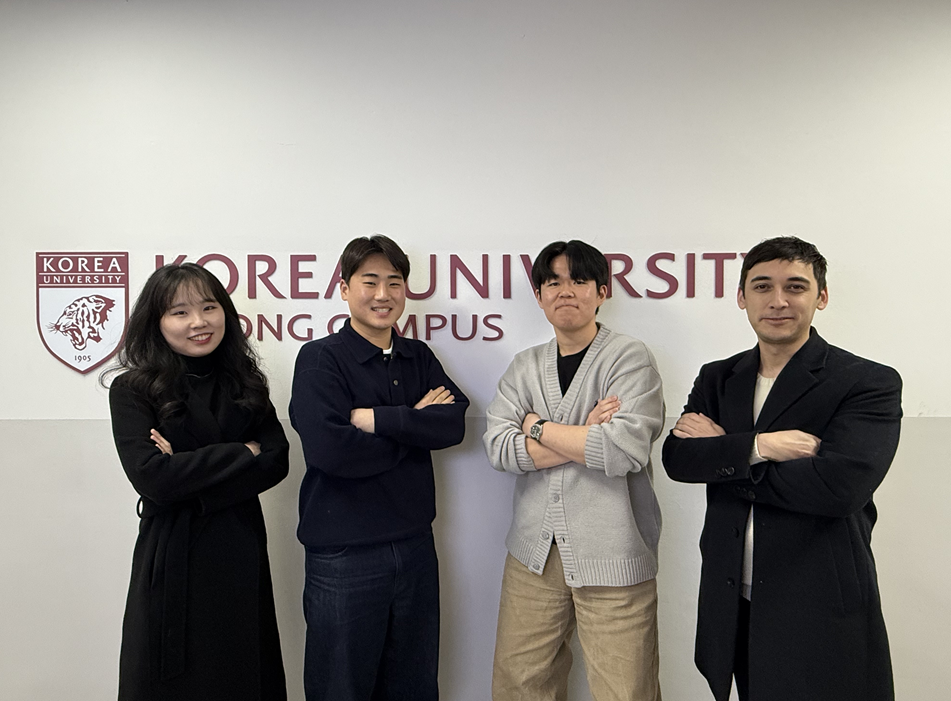
Research teams led by Professor Trevon Badloe and Professor So Sunae present a systematic analysis of AI-metaphotonics convergence
Proposes a new research direction for high-speed optical design and 'End-to-End' automation
A research team led by Professor Trevon Badloe (Department of Electronics and Information Engineering) and Professor So Sunae (Department of Electro-Mechanical Systems Engineering) at Korea University Sejong Campus has published a paper systematically analyzing convergence trends in Artificial Intelligence (AI) and metaphotonics, outlining future research directions for the field.
This study was conducted as a large-scale international collaborative project involving research teams from the Singapore University of Technology and Design (SUTD), École Polytechnique Fédérale de Lausanne (EPFL) in Switzerland, Zhejiang University, and Beihang University in China. The paper comprehensively summarizes the impact of AI technology on the design and analysis processes of metaphotonics.
Traditional optical components are often bulky, limiting their application in compact electronic devices such as smartphones and wearables. To address this, 'metasurface' technology, which precisely controls light by arranging nanoscale microstructures, has gained significant attention. However, metasurfaces involve a vast number of design variables, leading to substantial computational time and resources required to identify optimal structures.
To solve these challenges, the research team summarized the latest trends in AI-driven metaphotonic design and analysis. In particular, the study highlighted that AI-based simulations can predict optical properties thousands of times faster than conventional methods, opening the possibility of exploring novel metasurface structures that transcend human intuition.
Furthermore, the team confirmed that AI can precisely interpret subtle optical characteristics that are difficult to capture through traditional means by analyzing complex spectral and imaging data generated by metasurfaces. This suggests the potential to implement clearer and wider optical images by using AI-based software to compensate for limitations such as chromatic aberration and narrow fields of view in metalenses.
Looking ahead, the research team emphasized the development of 'End-to-End' automated systems, from the design stage to actual operation, positioning AI as a core tool for metaphotonic engineering. These technologies are expected to be utilized in various future industries, including autonomous driving, ultra-high-speed communications, next-generation displays, and biosensing.
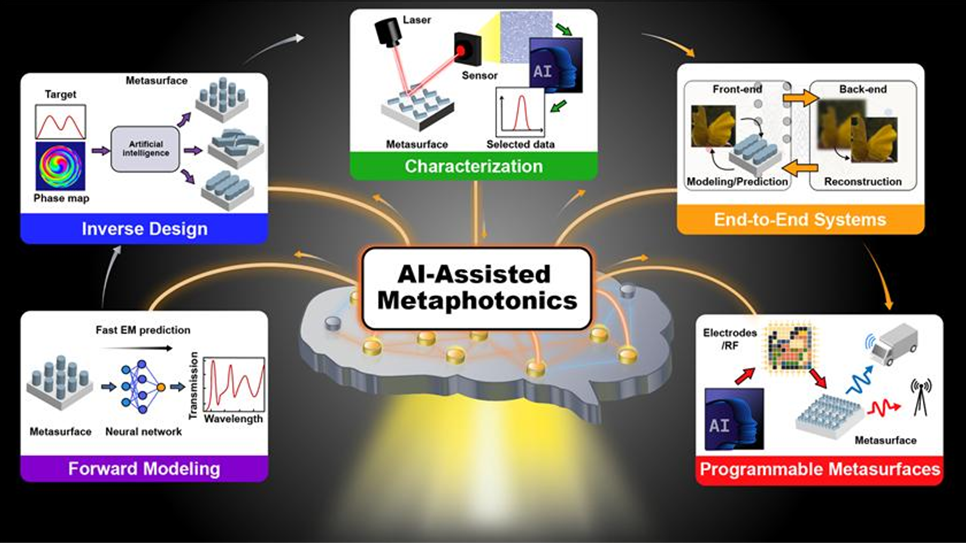
The research results were published in the March 2026 issue of Opto-Electronic Advances (OEA) (Impact Factor 22.4, JCR Top 3%, ranked 5th globally in the field of Optics). The paper is titled "AI-assisted metaphotonics."
Master's students Kang Minsung (Department of Electronics and Information Engineering) and Choi Seokju (Department of Control and Instrumentation Engineering) participated as co-first authors. Professor Trevon Badloe and Professor So Sunae supervised the research as co-corresponding authors.
This research was supported by the Alchemist Project of the Ministry of Trade, Industry and Energy (MOTIE) and the Korea Evaluation Institute of Industrial Technology (KEIT), the Regional Innovation System & Education (RISE) project of the Sejong RISE Center (supported by the Ministry of Education and Sejong Special Self-Governing City), and the Sejong Science Fellowship of the Ministry of Science and ICT (MSIT) and the National Research Foundation of Korea (NRF).